

The Kinaba Timeline
Home > About Kinaba Information Centre > The Kinaba Timeline
The vision begins
1970
Sir Thomas Hiley approached the Queensland Government to offer financial support from the newly formed Bird and Wildfowl Society for projects focused on wildfowl conservation.
The aim was to support:
“the preservation and public observation of native bird species in their natural environment.”
Planning the Kinaba project
1977
The Sir Thomas Hiley Fund was formally established to finance a major conservation and education project.
The original proposal identified a site at Kippa-Ring in Brisbane. However, surrounding development eventually made the location unsuitable.
Attention then shifted to the Kinaba Wetland Area within Cooloola National Park.
Key funding milestones included:
- approximately $100,000 initially raised by Sir Thomas Hiley and supporters
- an estimated construction cost of around $200,000
- a $50,000 special Treasury grant to be spent within a single financial year
- additional funding from Queensland National Parks and Wildlife Service (QNPWS)
By January 1979, QNPWS had contributed $180,033 toward the project.
The Queensland Works Department assisted with:
- architectural design
- planning
- tender management
- project supervision
Construction begins
1978
Construction commenced in May 1978.
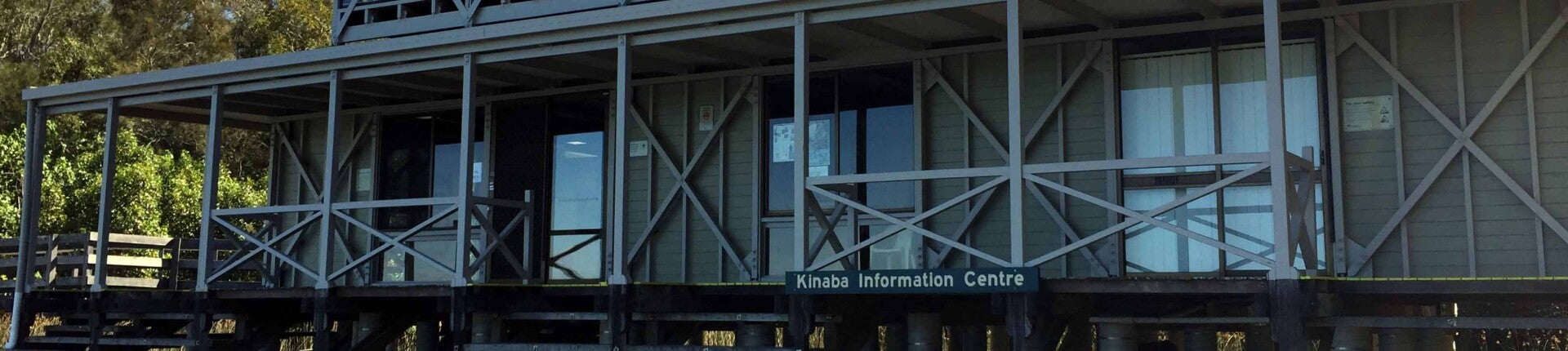
Robertson Brothers of Gympie secured the building contract and employed approximately 20 workers on the project.
The remote location required significant preparation and engineering work.
Construction highlights included:
- 168 piles sunk to depths of 4.5–5 metres
- spotted gum used for the structural framework
- horizontal 6x1 cypress tongue-and-groove cladding installed throughout
Although not fully completed, the centre officially opened on 16 September 1978.

Opening to the public
1979
Kinaba officially opened to the public in March 1979.
The Bird and Wildfowl Society contributed a total of $73,000 toward the project.
Management and visitor services
1979–2000: Permanent ranger presence
For more than two decades, two National Parks Rangers were stationed onsite 24 hours a day, seven days a week.
Their responsibilities included:
- welcoming visitors and tour boats
- answering public enquiries
- delivering interpretive talks to school groups
- recording weather observations and visitor numbers
- sharing conservation information
- preparing nature notes
- conducting patrols along the Upper Noosa River and Everglades
- maintaining the building, jetty, walkways and surrounding grounds
Since 2000
Permanent daily staffing at Kinaba ceased after 2000.
During this period:
- maintenance became limited to basic upkeep
- Queensland Parks and Wildlife Service shifted much of its focus toward beach compliance activities
2005–2010
A total of 53,847 campers visited the Kinaba area between 2005 and 2010.
Day visitors and tour groups significantly outnumbered overnight campers.
Proposal to restore and reinvigorate Kinaba
2011 — Formation of Friends of Kinaba
At a public meeting in July 2011, residents of Boreen Point voted to establish the Friends of Kinaba.
The group aimed to:
- restore and reactivate the Kinaba Information Centre
- provide volunteer staffing
- deliver conservation education to visitors
- retain Kinaba as a publicly accessible community asset
A steering committee was formed to:
- hold regular meetings
- gather supporting documentation
- build community networks
- prepare a formal proposal for the Department of Environment and Resource Management (DERM)
The group also began hosting community picnics at Kinaba to encourage public engagement and awareness.
2012 — Community support grows
In June 2012, after extensive consultation and strong community backing, the Friends of Kinaba finalised and submitted their proposal to DERM.
Support came from numerous organisations including:
- Noosa Parks Association
- Queensland Parks Association
- Noosa Biosphere
- Noosa Integrated Catchment Association (NICA)
- Boreen Point CCA
- Boreen Point Sailing Club
- Noosa Landcare
- Cooloola Coastcare
- members of the Boreen Point community
NICA also offered to auspice the group by providing volunteer insurance and additional support networks.
During the year, the Minister, Steve Dickson, advised that an Expression of Interest process would soon be advertised.
Community picnics continued throughout the year, while the website helped generate further public interest and awareness.
2013 — Restoration work begins
In May 2013, Friends of Kinaba and Landcare jointly submitted a Friends of Parks small grants application to fund:
- restoration materials
- revegetation work at Elanda Plains
Although no further progress was announced regarding management arrangements, the Minister confirmed that management rights had not been granted to any external parties.
Several Friends of Kinaba members were inducted as National Park volunteers while awaiting approval to begin restoration work.
Community member Jim Bennett donated a dinghy to transport volunteers and equipment to Kinaba.
In September 2013, Workplace Health and Safety officers began formally inducting volunteers, allowing restoration work to commence.
Initial works included:
- extensive cleaning
- oiling timber structures
- replacing posts, decking and joists
- asbestos inspections
Additional donations and support continued to come from the Boreen Point community.
2014 — February to July
Volunteer working bees and community picnics continued throughout 2014.
Key activities included:
- Full moon working bees and picnic gatherings
- Additional restoration improvements completed
- Cleaning and painting works
- Wire-brushing and maintenance of structural bolts
- Inspection of peeling paint over asbestos surfaces
- Confirmation that undercoat sealing remained in good condition
- Painting ceilings in asbestos-tested safe areas
- Painting beams and continued maintenance of structural bolts