

History of Kinaba
Home >About Kinaba Information Centre > History of Kinaba
Protecting Cooloola
From the early 1960s, the Noosa Parks Association and the Cooloola Committee led a passionate campaign to stop sand mining in the Cooloola region. Their efforts helped shift public opinion and eventually pressured the Queensland Government to protect the area as a National Park.
Sir Thomas Hiley's vision
Sir Thomas Hiley (1905–1990), Queensland Treasurer from 1957–1965 and founder of the Bird and Wildfowl Association of Queensland, proposed in 1970 that funding be provided for:
“a project to promote the preservation and public observation of native bird species in natural environments.”
Between 1970 and 1976, extensive surveys were undertaken to identify a suitable location for the project.
Some critics at the time questioned whether members of the Bird and Wildfowl Association were more interested in shooting wild birds than observing them.
Building the Kinaba Information Centre
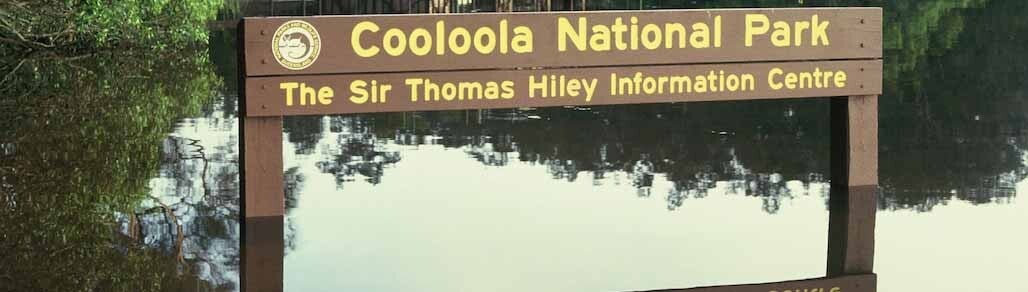
Following the declaration of Cooloola as a National Park, the Queensland Government moved to establish the Sir Thomas Hiley Information Centre at Kinaba as a gateway to the protected Upper Noosa River.
Funding for the project included:
- $70,000 from the Bird and Wildfowl Association
- $50,000 from Queensland Treasury
- $180,000 from the Queensland Government
Construction was awarded to Robertson Brothers of Gympie.
Work began in May 1978 and was completed ahead of schedule in September that year.
Construction in a remote environment
The project required considerable ingenuity.
A team of 34 workers first constructed a barge to transport materials across the lake. They then installed 168 piles to support the building and elevated walkways.
Materials included:
- Spotted gum for the frame, steps and seating
- Cypress tongue-and-groove cladding, left unpainted
Opening Day - and an awkward silence
Kinaba officially opened in March 1979.
Queensland National Party ministers praised both the building and the declaration of Cooloola National Park. However, there was no acknowledgement of the long conservation battle that helped protect the region.
None of the campaigners involved in the anti-sand mining movement were invited to the opening.
Kinaba in its early years
When the centre opened, two Queensland Parks and Wildlife Service staff were permanently based at Kinaba. Although permanent staffing ceased more than a decade ago, visitor numbers have remained strong.
In its first year alone, the centre welcomed around 50,000 visitors. Between 2005 and 2010, approximately 55,000 campers visited the area, with day visitors and tour groups far exceeding overnight stays.
The Friends of Kinaba
In July 2011, residents of Boreen Point formed a steering committee to help restore and reactivate the Kinaba Information Centre.
Their aim was to:
-
preserve the building
-
educate visitors
-
protect public access
-
keep the facility in public ownership.
The group, known as the Friends of Kinaba, submitted a proposal to the Department of Environment and Resource Management and later participated in a formal Expression of Interest process.
Restoration begins
In August 2013, several members of the Friends of Kinaba were inducted as National Park volunteers.
Restoration work officially began in October 2013 and included:
- a major site clean-up
- maintenance and repairs
- oiling and painting the building and walkways
- development of interpretive display panels.
An application for funding through the Friends of Parks Small Grants program was unsuccessful.
References:
Gympie Times, Saturday September 16, 1978.
‘The Cooloola Conflict’, Dr. Arthur Harrold, Noosa Parks Association